Showing posts with label Ferdinand E. Marcos. Show all posts

Wednesday, September 21, 2022

MY STAND ON THE QUESTION, DID MARTIAL LAW SAVE THE PHILIPPINES FROM TOTAL COLLAPSE?


MY STAND ON THE QUESTION,
DID MARTIAL LAW SAVE THE PHILIPPINES FROM TOTAL COLLAPSE?

“What this (democratic) revolution requires is a political leadership that finds reason to institute radical reforms and, more important, has the courage to act on behalf of the people, and thus against the (oppressing) oligarchy, including its power brokers in the ranks of the intellectual elite..... Of what good is democracy if it is not for the poor?!”

                   – Pres. Ferdinand E. Marcos, An Ideology for Filipinos (1980)


First of all, don’t get me wrong. I don’t favor Martial Law, for the simple reason that it has dark attributes. It can be used by some ambitious military officers for their own selfish agenda. If you read the older President Marcos’ writings, you’ll know too that he was forced by circumstances to declare it. It was an unwanted necessity.

Now, however, if you ask me, did the declaration of Martial Law saved the Philippines from total collapse during Marcos’ time? The answer is an absolute “yes!”

After the devastation and chaos brought about by the Luzon-wide flood of 1972, the Philippines was in deep turmoil. The CPP-NPA and Muslim secessionists took the dire circumstance as an opportunity to sow greater unrest in the country. Then there was the food and energy crises worsen by the increasing global oil prices.

The then Congress, controlled by bureaucrat capitalists, fascist oligarchs and landed elites, prevented socio-economic reforms. The government was at a virtual standstill and immediate, decisive, actions need to be executed in order to save the republic.

On September 21, 1972, Pres. Marcos signed Proclamation No. 1081 placing the entire country under Martial Law. Two days later, he announced it through radio and television broadcast.


Being once upon a time having a radical revolutionary thinking; I was almost recruited by the Kabataang Makabayan of “Ka Nilo” Tayag and later mentored by Dominador “Ka Domeng” Arellano, two prominent figures in the Philippine social activism movement, I am not ignorant of the history of “struggles” of the Filipino masses. In a way, I was at the forefront of it.

I was still a student when Martial Law was declared. And mind you, I was an activist vocally speaking against it. Well, it was cultivated by the experience of our house being demolished without due compensation and the hardship me and mother suffered transferring from one residence to another. But I’m also observant of the things happening around me.

During Martial Law, people were disciplined, there was almost zero crime rate, and the people in public service were courteous. You can leave your bicycle on the street corner without fear of it being stolen. There was no red tape and document transactions with government agencies were fast and efficient.

It was during the Martial Law time when the Land Reform Program of the Marcos administration was set in motion, unhampered by feudal lords-lawmakers. Thousands of tenant farmers were given land titles, finally owning the land they till as tenants for decades.

The Philippines enjoyed its best economic development between 1972 and 1979. The economy grew despite two severe global oil crises in 1973 and 1979. World Bank data also show that Philippine Agriculture, crops (rice, corn, coconut, sugar), livestock and poultry, and fisheries grew at an average rate of 6.8, 3.1 and 4.5 percent, respectively from 1970 to 1980. During the Marcos’ “Green Revolution,” the annual rice production in the Philippines increased from 3.68 to 7.72 million tons in two decades and made the Philippines a rice exporter for the first time in the 20th century.

In the field of environmental concern, no other president made such radical and drastic move of abolishing the Philippines’ log exports. Upon seeing the studies made regarding Philippine forest, that the rate of falling trees was nearly a hectare per minute, Marcos issued a series of conservation decrees. In 1973, he directed the phasing-out of log exports and set January 1976 as the deadline for a complete stop. Under Martial Law, the once powerful logging concessions in the country could only whimper. Tree farming, on the other hand, was added as a “pioneer industry” in the investment incentive list of the Board of Investment. Marcos also enjoined the C.A.T. and R.O.T.C. cadets to participate in tree planting throughout the country. More than 10 million trees were planted and, by the early 1980s, areas near watershed were already reforested. Sadly, however, after Marcos was removed from power, the logging concessions returned and even the reforested areas were logged over bald.

Mathematics do not lie. Five of the eight major dams and 17 hydroelectric and geothermal power plants still fully functional today were constructed during the Marcos administration. No other president before or after Marcos was able to achieve such a feat. Aside from this, more than 90 percent of the bridges, more than 70 percent of the roads and highways, over 40 percent of the state colleges and universities still existing today throughout the country were built by the Marcos government.

Finally, it was only Pres. Marcos who has the initiative to establish a genuine Filipino Ideology, one which is based on endemic values, tradition and culture, neither left nor right, but a confluence of what is applicable to the Philippine setting.

So, again, if you ask me, “Did Martial Law save the Philippines from collapse ?” Yes, indeed!


I was in third year high school when I won an essay writing contest – “How Can the Youth Help in the Building of the New Society?” – sponsored by the Office of the President. My essay, titled Revolution from the Center, was critical of the Marcos government that when the news that I am being invited to Malacañang was relayed to me by our assistant principal, shivers ran up and down my spines.

Without recalling all the details of what transpired during those unanticipated experiences, I will just try to recall some of the key contents of that essay, among them: That for a revolution to succeed, it must come neither from the left nor the right, but from the middle – a revolution from the center; that the government can start that revolution with radical and revolutionary changes in its policies and social actions; that government goes to the grassroots of the grievances of the people and listen with sincerity; that government uses its power to balance the grave inequality between the poor majority with the rich minority and its resources and ascendancy to conquer or at least attempt to conquer poverty.

Suffice to say, I was among the seven winners and with that I had the rare, nervous, shivering, privilege to talk to Minister Victor G. Nituda, head of the Malacañang Press Corps, and President Marcos himself.

It would still be years of research and profiling before I would be convinced to change my political viewpoint. But I did and, notwithstanding the difficulties in life that my mother and I experienced, I do not regret it. I saw the comparison; I am a living witness of both the Marcos Era and post-Marcos Era; and I know the truth and the lies.


READ ALSO:
THE PRESIDENT MARCOS LEGACY

Sunday, September 11, 2022

PRESIDENT FERDINAND E. MARCOS: ON THE FRONT COVERS OF MAGAZINES


FERDINAND E. MARCOS ON THE COVER

Today, September 11, 2022, is the 105th birth anniversary of Ferdinand Emmanuel Edralin Marcos Sr (1917-1989), the man who served longest as president of the Republic of the Philippines.

Many things have been written about him. During his ascent to the highest office of country, good and promising; during his early incumbency, praises and accolades; during his reelection, visions and reformations, during his struggle against the oligarchy, encouragements and criticisms; during his last days in power, woes and worries; and during the reign of the Yellow Regime, defamation and lies.

Indeed, much of the written accounts about President Marcos inside books and textbooks printed after February 1986 have been polluted by halftruths and lies that the younger generation of Filipinos have difficulties discerning the truth, especially with so much fake news being disseminated by the oligarch-controlled yellow media. Looking back, it was the first act of Cory Aquino as president to purge all the good things that Marcos did, burn the documents, and replace them with all anti-Marcos concoctions they could invent. They pursued this for more than three decades until finally everything exploded in their faces.

Well, no matter what has been said and written about Marcos, one truth cannot be denied of the man – he had left a legacy so great no forces could purge, burn or topple them.

In commemoration of President Ferdinand E.Marcos’ legacy, here are several magazines with him on the covers.

Philippine Free Press (November 20, 1965).

The Sunday Times Magazine (November 28, 1965).

Time (October 21, 1966).

The New York Times Magazine (with Imelda R. Marcos, February 26, 1967).


Sunday Observer (March 18, 1973).


Liwayway (June 15, 1981).

Chinatown East (October 20, 1982).

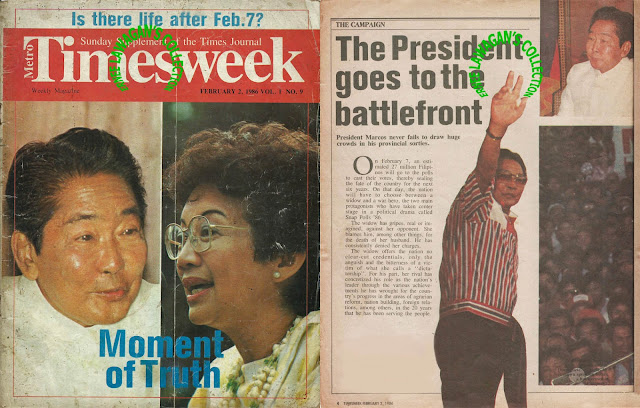
Metro Timesweek (against Cory Aquino, February 2, 1986).

Time (against Cory Aquino, February 3, 1986).

Newsweek (March 3, 1986).

Asiaweek (with Imelda R. Marcos, July 5, 1987).

Sunday Inquirer Magazine (February 19, 1989).

Philippine Free Press (with the Marcos Family, April 15, 1989).

Asiaweek (October 13, 1989).

You know, history has the uncanny ability in correcting itself, and karma has a way of getting back at those who tried to distort history. Behold, as it unfolds! His son, Ferdinand "Bongbong" R. Marcos Jr, recently won a landslide victory, by an absolute majority of 58.77 percent of the electorates. It was indeed a historic vindication, Poetic justice – Iginuhit ng Tadhana (drawn by destiny).


Thursday, June 23, 2022

WHY THE MARTIAL LAW ERA NEEDS TO BE DISCUSSED?


WHY THE MARTIAL LAW ERA
NEEDS TO BE DISCUSSED?


Press Secretary & Presidential Communications and Operations Office (PCOO) Chief, Rose Beatrix “Trixie” Cruz-Angeles, recently made a statement: “Martial Law is a mine in itself... Why don’t we allow a discourse? I think everything should be open to debate, even scientific theories and established facts are always open to question... We don’t have to come to a conclusion. Let us not limit discourse...”
To this the yellow and pink trolls reacted so obviously without thinking. So biased and one-tracked, they are stuck with the argument that Martial Law is all bad.
One particular comment is from a self-proclaimed political analyst, Richard Heydarian: “FYI, there’s nothing to debate on dictatorship, especially the uber kleptocratic kind that produced zero world class industries a la neighboring Taiwan and Korea. Facts clearly show: It was a governance, economic and human rights disaster on so many level! Period!”
A real political analyst would know the moment he read his comment that this guy is a quack – a pinquack!
Allow me to point the real facts, social, economical and historical, the Cory government tried to erase in collaboration with the oligarchic-controlled media.
During the Martial Law era, the people were discipline and valued the traditional giving of respect to their parents and grandparents, to older people, to people in authority. Law and order are strictly preserved. You can walked at night alone without fearing of getting mugged or robbed; you can leave your bicycle in the street unattended without fearing it being stolen; narcotics are a rarity because drug lords are not cuddled but sent to the firing squad! In fact, it was probably the only time in history when the chaotic Divisoria is clean and orderly!
Economically, the Philippines was at its peak during the administration of President Ferdinand E. Marcos. The rice crisis inherited from the previous administation was solved through pioneering government programs and, by the middle of the 1970s, the country was already a rice exporter, probably the only time in our history that it happened.
Anti-Marcos proponents alleged that the Philippines was the “sick man of Asia” during the Martial Law Era. Again, this was the result of Cory Aquino Regime policy of adulterating the school textbooks. Looking back at history and World Bank records, however, says otherwise. The “sick man of Asia” connotation perhaps better pertained to the Philippines that Marcos inherited from President Diosdado Macapagal.
Based on World Bank data, the Philippines’ Annual Gross Domestic Product grew from 5.27 billion dollars in 1964 to 37.14 billion dollars in 1982, and Philippine GDP per capita more than quadrupled from 175.9 dollars in 1964 to 741.8 dollars in 1982, the second highest in Philippine history. Though it fell to 568.8 dollars in 1985. This despite many compounding factors, including extremely high global interest rates, severe global economic recession, and significant increase in global oil price, which affected all indebted countries in Latin America, Europe, Asia, and the Philippines was not exempted. All in all notwithstanding the 1984-1985 recessions, GDP per capita grew at an annual rate of 5.8 percent. Indeed, according to the U.S. based Heritage Foundation, the Philippines enjoyed its best economic development between 1972 and 1979. The economy grew despite two severe global oil crises in 1973 and 1979. World Bank data also show that Philippine Agriculture, crops (rice, corn, coconut, sugar), livestock and poultry, and fisheries grew at an average rate of 6.8, 3.1 and 4.5 percent, respectively from 1970 to 1980. During the Marcos’ “Green Revolution” and “Masagana 99” programs, the annual rice production in the Philippines increased from 3.68 to 7.72 million tons in two decades and made the Philippines a rice exporter for the first time in the 20th century. Mathematics do not lie. No other president before or after Marcos was able to achieve this.
The anti-Marcos accused the former president of stealing tens of billions of dollar from the government coffers during his rule. The reality of which no factual or physical evidence has been presented in any court except for intangible allegations. In fact, most of the cases filed against the Marcoses both here and abroad were already dismissed. Marcos himself was quoted as saying: “I have committed many sins in my life. But stealing money from the government, from the people, is not one of them.” How do we go about checking this?
Again let’s do the Math, or the logical estimates, at least. How much money is there really in the Philippine coffers during the Marcos administration? If we include the local and foreign funds, donations and debts, how much money was there available for Marcos? Now, let’s go to government expenditures, how much money do you think his government spent with all the infrastructures built during his time? Five of the eight major dams and 17 hydroelectric and geothermal power plants still fully functional today were constructed during the Marcos era.
In 1983, the Philippines became the second largest producer of geothermal power in the world with the commissioning of the Tongonan 1 and Palinpinon 1 plants. It is also worth mentioning that because of the focus of the Marcos government on renewable energy sources, the country’s dependency on hydrocarbon fuel was at its lowest from the late 1970s to the early 1980s.
Aside from this, more than 90 percent of the bridges, more than 70 percent of the roads and highways, over 40 percent of the state colleges and universities still existing today throughout the country were built by the Marcos government. Not to mention the Light Railway Transit (LRT) system, sea and air ports, irrigation and flood control projects, water supply and drainage facilities, the Kidney, Heart, and Lung Centers, thousands of public markets, hospital and health facilities, arts and cultural buildings, etc. Marcos also spearheaded the development of 11 heavy industrialization projects including steel, petrochemical, cement, pulp and paper mill, and copper smelter. Add to that he Pilipinized major industrial companies previously owned by foreign congomerates.
Historians will one day ask: What would the Philippine Archipelago be without the Pan-Philippine Highway? What would Luzon be without the Candaba Viaduct, the North Luzon Expressway and the South Luzon Expressway? What would Visayas be without the San Juanico Bridge? What would Mindanao be without the Atugan Bridge?
During President Noynoy Aquino’s time, the entire archipelago suffered from drought and water shortage in an El Niño occurrence. The supply of water for irrigation in Bulacan and Rizal were cut-off just to maintain a reduced supply of drinking water for Metro Manila. Imagine if Angat, Ipo and La Mesa dams were not constructed during Marcos time. We would be exporting water from China, perhaps. On the other extreme, imagine if Magat and Pantabangan dams were not constructed. Northeastern and Central Luzon would turn into giant lakes during typhoon seasons. Imagine if the flood control system of Metro Manila was not rehabilitated during Marcos time. The inundation, destruction and damage after Typhoon Ondoy and the 2010 habagat onslaught would be more than tenfold. By the way, the Marcos government master plan of the flood control system for Metro Manila and surrounding suburbs was scrapped and construction discontinued during President Cory Aquino’s regime, simply because “it was a Marcos project.” No alternative plan was ever set in place. The same fate happened with the mothballed Bataan Nuclear Power Plant, which could have prevented the energy crisis of the 1990s and succeeding energy crisis that followed.
The 1986 revolt that ousted Marcos happened in the Ortigas intersection along the Epifanio de los Santos Avenue (EDSA). But did you know that EDSA (known as Highway 54 and Avenida 19 de Junio during President Manuel Roxas’ time), the 23-kilometer long highway we know today, was paved, lengthened, modernized and concretized by the Marcos government?
How much do you think all the aforementioned projects cost? Add the social services, the salaries of government workforce (civilian, police and military), and the miscellaneous expenses of the national government. I wonder, was there anything left to steal? The bigger wonder that the yellow and pink trolls refused to accept is the possibility that Marcos didn’t steal a centavo but, on the contrary, forked out billions to finance and complete his administration’s massive infrastructure projects.
These are concrete evidences that stood the test of time even though much of the records and documents concerning these Marcos programs and projects were ordered purge, burn and destroyed during Cory’s regime.
How about the allegation of human rights abuses? While there are real victims, it can be argued that he was not directly involved. Most of the cases happened during the time when he was already perceived to be at ill-health. He was not the one signing the arrest warrants nor ordering the alleged torture, abduction or killing, and he was not at his full faculty during the time. According to Amnesty International, most of the human rights abuses emanated from the Philippine Constabulary controlled by then General Fidel V. Ramos, who later staged a coup against Marcos. With favors and influences coming from the Democrats bloc in the United States, he was installed as president of the Philippines after Cory Aquino.
The alleged human rights victims were said to number more than 120,000. That many? One might want to check the list. Were they all happened during Marcos’ time? And again, did he really order the arrest and torture, or was it Ramos and the Constabulary, a tactical maneuver offered by the C.I.A. to create chaos and add dissent by the people against the Marcos’ government? I’m very sure the list will shrink considerably upon close scrutiny.
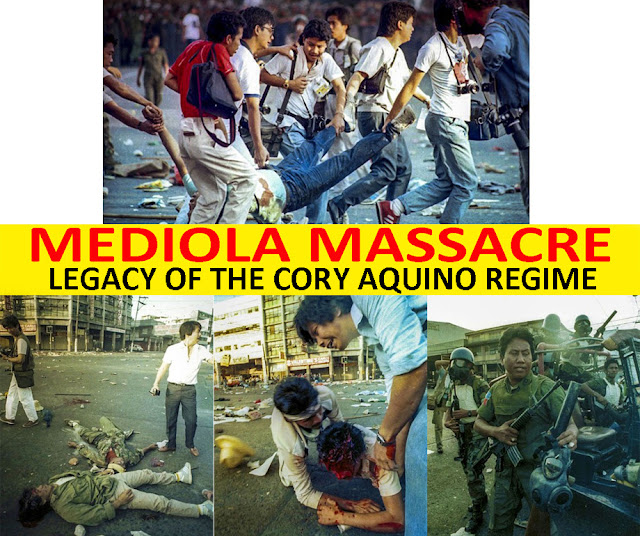
Every administration has a share of its gruesome acts of human rights abuses. Has everyone forgotten the 1987 Mendiola Massacre? The Hacienda Luisita Massacre? How come no one, no command responsibility prosecution was made accountable for this grave killing of peasants? Let us not splash a stigma on Martial Law or on one administration alone.
As we remember Marcos’ undoing, we should also recall his one last act of statesmanship. At the height of the EDSA Revolt, General Fabian Ver was coaxing President Marcos to launch an all-out offensive against Ramos and Enrile, but he refused because many civilians will be caught in the crossfire. That part was seen on television, but not once was it replayed. Had Marcos agreed to Ver’s plan, the scenario would be like the Tiananmen Square carnage in China. Thousands would have perished. Colonel Irwin Ver, then head of Presidential Security Command (PSC), in an interview recalling his last days at Malacañang, remembered Marcos ordering him for “strategic withdrawal to Ilocos.” When he apprised the president that they still have the capability to defend the palace for a long time, the latter responded: “I don’t want us to be shooting at our own people. We must resolve this peacefully.” In the young Ver’s own account: “Here’s my president who many thought was a monster, his back forced against the wall, and though armed with tremendous firepower at his disposal, would not fight his way out, but clear in his mind that he would rather avoid it. At the point when the only option left was to defend the seat of presidency, he chose to leave. He would not fire back at those who were ready to shoot him down. At that moment, I felt deep in my heart that I have served the right commander-in-chief.” Marcos’ last act of ceding power rather than see the shedding of a Filipino’s blood is a noble legacy in itself.
Incidentally, some miswritten books and Internet blogs should be corrected: Marcos didn’t flee to Hawaii. He wanted to go to Paoay, Ilocos Norte, but he was “kidnapped” to Andersen Air Force Base in Guam, before being taken to Hawaii, on the adamant insistence of Cory Aquino to U.S. Ambassador Stephen Bosworth that Marcos should be exiled outside of the Philippines immediately. There are documents, tapes and records to this effect.
Most Filipinos would know that Ferdinand E. Marcos as the tenth president of the Philippines who ruled for 20 or so years. Political information buff would know that he was once a Liberal Party member and the aide of former president Manuel A. Roxas; that he and Benigno “Ninoy” Aquino were best of friends then; that he became the Philippines’ youngest Senate President in 1963; that he joined the Nationalista Party and became its presidential nominee in 1965 after then incumbent president Diosdado Macapagal reneged an agreement that Marcos would be the next LP standard bearer; that he first became president in 1965 beating reelectionist Macapagal; and that he founded the Kilusang Bagong Lipunan (KBL) in 1977. Trivia enthusiasts, on the other hand, would know that his favorite numbers are 7 and 11; that he garnered 98.8 percent in the 1939 Bar Examination, the highest score ever recorded; and he was the Philippine Free Press “Man of the Year” in 1965.
Did you also know that from 1972 to 1986, the Marcos Administration codified laws through 2,036 Presidential Decrees, an average of around 145 per year during the 14-year period? To put this into context, only 11, 12, and 14 laws were passed by the Aquino administration in 2013, 2014 and 2015, respectively. Almost all of the laws passed during the term of Marcos remain relevant, still in force today, and are embedded in the country’s legal system.
Without going into lengthy arguments about his military medals, as there are those who claimed they were fake, two American presidents confirmed the awarding of those medals.
On August 8, 1985, President Marcos received a Soviet Medal of Valor “in recognition of his deeds and heroism against the forces of fascism and militarism” during World War II. And this is on record.
There are, however, many things yet probably unwritten about Marcos. Do you know for instance that his favorite color is white and red? White because, according to him, “is the essence of purity of mind, heart and spirit,” and red “represents courage and revolutionary thought.” Now you know why Marcos Loyalists wear red t-shirts.
Now let’s go on to heavier matters. Activists, radical, reactionary or otherwise, have been calling Marcos tuta ng Kano (American puppet), even until now. Let’s cite some instances which prove this wrong. On his first term as president, Marcos received a note from visiting U.S. president Lyndon B. Johnson asking him to announce publicly that he should send Filipino combatants to Vietnam. Marcos folded the note, put it in a matchbox and throw it in the waste can. In his speech, he vehemently refused: “As long as I am president, I will not send armed combatants to Vietnam.” He sent an engineering battalion and a medical mission instead. President Johnson got mad and was quoted as saying “who does this McCoy think he is?” The western press picked-up on the slang “McCoy.” When Tagalized out came Marcos’ street sobriquet, Makoy.
Another casing point is the declaration of Martial Law, the act of which became sort of a phobia among its victims and his political nemeses and, up to now, is being used as a national stigma. We will not talk about the reasons for declaring Martial Law (as there are a lot of Internet sites where you can google them), but the act itself. Immediately after it was declared on September 1972, U.S. president Richard M. Nixon called on Marcos telling him to abort and that the U.S. government will not support this action. Marcos defied “Uncle Sam,” the first and perhaps the only Philippine leader, until President Rodrigo Duterte, to do so. Since then, his friendship with Nixon soured.
Martial Law, with all the ill-effects glued to it, was also instrumental in pushing for the much-needed economic and social reforms in the country. It stopped the lethargic bureaucracy of the Philippine Congress. “The powerful opponents of reforms were silenced and the organized opposition was also quilted. In the past, it took enormous wrangling and preliminary stage-managing of political forces before a piece of economic reform legislation could even pass through Congress. Now it was possible to have the needed changes undertaken through presidential decree.” This was aptly pointed out by University of the Philippines economics professor and former NEDA Director-General Dr. Gerardo Sicat.
President Duterte is being recently lambasted by rightist and oligarchic elements for having an independent foreign policy. That is, a foreign policy not solely, mendicantly, dependent on the U.S. He is, however, not the first president to do so. In 1975, then First Lady Imelda Marcos went to Cuba. She learned from Fidel Castro that “after 30 years, any lease agreement between sovereign nations concerning land occupancy becomes permanent, and may only be abrogated by mutual consent.” This was based on Cuba’s experience regarding the Guantanamo Naval Base. That is how the base inside Cuba became US property. Since sovereignty was absolute within the premises of the said base, and the lease agreement cannot be unilaterally terminated. Upon knowing this, she immediately told President Marcos knowing fully its parallel consequence on Clark Air Base and Subic Naval Base.
The US military bases in the Philippines were established through the Parity Agreement in 1947, which also started the so-called “mendicant foreign policy.” Interesting to note that it was President Roxas who initiated this policy. Claro M. Recto and Jose P. Laurel opposed it. President Roxas even made a public speech of loyalty (according to Recto, more like subserviency or sycophancy), “kissing the American anus,” at the Kelly Theater on April 15, 1948.
After the abolition of the 1935 Constitution, and the ratification of the 1973 constitution, subsequent amendments and provisions thereafter was made and the military bases became renegotiable every five years. This made it possible for the Philippine Senate under Jovito Salonga to vote for the removal of the bases in 1991. President Cory Aquino was for the status quo. In reality, it is Marcos that we should thank, for the removal of the US military bases. Senator Salonga, for his part, paid a dear price for disobeying President Aquino. He was voted out as Senate President and his financial backer in the business community withdrew their support for his presidential bid.
Aside from this, current brood of students of activism should also know that it was during the Martial Law era that Claro M. Recto’s dream of cutting the chain of “mendicant foreign policy” became a reality. On April 1972, President Marcos initiated the establishment of diplomatic relations with socialist countries of Asia and Europe, which led to progressive trade relations and cultural exchange programs. This in turn marked the end of the Philippines’ period of mendicant policy in foreign affairs and the beginning of a new era of self-reliance. Recalling history, Marcos went to China in June 1975, where Chairman Mao Zedong shook his hand and told him “You must lead the Third World.” The following year, he visited Moscow and established diplomatic ties with Russia.
We owe it all to Recto’s dream and Marcos’ act of defiance against the US. Perhaps, the foremost reason, more than the alleged charges of abuses he committed, why he was stabbed in the back by “Uncle Sam” and ousted from office.
Can Marcos be considered a revolutionary? Before many activists’ eyebrows start flying, let’s profile the man through his writings and principles. In his book The Democratic Revolution in the Philippines (1979), he wrote: “The Democratic Revolution is a rededication to the historical aspirations of the Filipino people, but it makes demands not only on the political authority itself but on the very foundation of that authority: the people,” and “The fundamental reason for building a new society involves the outstanding fact of our age: the rebellion of the poor. This is a rebellion over which the might of government can have no avail, for the poor are, in many ways, the people for which government exist.” It gets more intense in the succeeding book, An Ideology for Filipinos (1980): “What this (democratic) revolution requires is a political leadership that finds reason to institute radical reforms and, more important, has the courage to act on behalf of the people, and thus against the (oppressing) oligarchy, including its power brokers in the ranks of the intellectual elite.” He summed it up with his rallying cry: “Of what good is democracy if it is not for the poor?!”
One of the primary objective of Marcos establishing a “new” society is the “conquest of poverty.” Among the poorest poor and the most exploited in the Philippines are the peasant farmers. Land reform was the priority program of the Marcos presidency. But the fact is that before Martial Law was declared, the Philippine Congress was occupied mostly by landlords, oligarchs owning huge landed estates, and feudal vassals, and any and all attempts to pursue a genuine land reform program will not even reach first reading. Marcos had enough of this: “Our people have known enough of exploitation. It is time that our people shared equitably in the fruits of their labor and their land.”
On September 26, 1972, just five days after declaring Martial Law, Marcos decreed the entire country a land-reform area. A month later, he enacted the “Tenant Emancipation Decree.” It was put on paper with his own handwriting: “Decreeing the emancipation of tenant farmers from the bondage of the soil, transferring to them the ownership of the land they till, and providing the instruments and mechanism thereafter....” Marcos wrote it with his own hand because he felt it was both the pioneering and milestone program of his “New Society,” and to show his sincerity. For he knew then: “If land reform fails, then the entire program of the New Society fail.”
In the field of environmental concern, no other president made such radical and drastic move of abolishing the Philippines’ log exports. Upon seeing the studies made regarding Philippine forest, that the rate of falling trees was nearly a hectare per minute, Marcos issued a series of conservation decrees. In 1973, he directed the phasing-out of log exports and set January 1976 as the deadline for a complete stop. Under Martial Law, the once powerful logging concessions in the country could only whimper. Tree farming, on the other hand, was added as a “pioneer industry” in the investment incentive list of the Board of Investment. Marcos also enjoined the C.A.T. and R.O.T.C. cadets to participate in tree planting throughout the country. More than 10 million trees were planted and, by the early 1980s, areas near watershed were already reforested. Sadly, however, after Marcos was removed from power, the logging concessions returned and even the reforested areas were logged over bald.
Marcos initiated the development of the “Filipino Ideology.” This he did with the help of former activists and rebels, Nilo Tayag, Noni Villanueva, Horacio Morales, Dominador Arellano, to name a few. Tayag was the co-founder of the Kabataang Makabayan (KM), the forefront of youth and student activism during the first to the fourth quarter storms, and the idea and founding of the Kabataang Barangay (KB) undoubtedly sprouted from this concept. Instead of protesting on the streets against policies of government, why not be part of improving such policies; be part of building a “New Society.” Many other ideas deemed revolutionary like the movement for livelihood and development, Kilusang Kabuhayan at Kaunlaran (KKK), the pro-consumer market, Kadiwa, the Green Revolution, the Masagana 99, the Sariling Sikap, etc., were instituted by Marcos upon the advice of these former activists and rebels.
Marcos was a man bound by a visionary objective: “Our revolution’s mandate, indeed, is to render to our people the justice and the good life that are their birthright. Translating this broad mandate into principles and specific policies is the great mission of our time.”
All these reasons bottled up in the hearts and minds of the Pilipino people. For three decades they waited until another Marcos is ripe enough to carry the torch left by his fathers. Then the outpouring, the volunteerism, the solidarity, the courage, the vigilance, exploded in the May 9, 2022 Presidential Election. Ferdinand “Bongbong” R. Marcos Jr won by absolute majority, with a margin of votes bigger than his closest rival. History cannot be stopped in correcting itself. Destiny maybe fulfilled.....

But there’s a lot more to tell!
[Posted on Facebook on June 7, 2022. Most of the contents were taken from my earlier Blogspot posts]


Tuesday, March 1, 2022

REPOST (Facebook - February 2022)


REPOST


February is probably known as the “month of love” because of the traditional celebration of Valentine’s Day, though there are so much confusion and misinformation as to the connection of a so-called Roman priest named Valentine to love and romance.

Anyway, as promised, here is the compilation of my Facebook posts for February 2022.


02-03-2022

FRIDAY FLASHBACK

        The yellows and the pinkwaks, and their misinformed followers keep saying that the government of Pres. Marcos condoned human rights violation. But they are blind to those committed by the Yellow Regime.

        Not even a year after the de facto government of Corazon “Cory” Cojuangco Aquino (1933-2009) took over, the Mendiola Massacre happened on January 22, 1987. It will be remembered in Philippine History as the Black Thursday were unarmed farmers were fired upon by the police, soldiers, and PSGs killing 17 and injuring several dozens more. Though the media were supressed, the grim memories and gruesome mementos of that infamous day will not be forgotten. Most of the photographs and documentations of that darkest of days were either confiscated and destroyed. Only a few remained to unveil the stories of horror and brutalities committed during the so-called Yellow Regime. Very few mainstream journalists during Cory’s reign – Louie Beltran (1936-1994), Renato Constantino (1919-1999), Melinda Liu, Catherine Manegold, Luis Teodoro, Rigoberto Tiglao, Luisa Torregosa –had the courage to tell the truth.

        Quite unknown to the general public, her regime committed a hideous record of the human-rights violation. From March 1986 to December 1991, the number of warrantless arrests and detention reached nearly 16,000. Extrajudicial executions, on record, numbered 1,733 cases, including 189 that occurred in 1990 alone. Only in recent years that much of the hidden atrocities of the Cory Regime were being uncovered, together with that of her son, President Benigno “Noynoy” Aquino III’s graft and corruptions, and other illegal activities. History is indeed will always correct itself. Tribulation and karma will in time reach all those who are the real culprits of injustices.


02-05-2022

WHY IS FACEBOOK PHILIPINES HARASSING BBM AND DDS ADVOCATES?

There’s a standing tenet in social media: “FAIRNESS & FREEDOM OF EXPRESSION MUST BE UPHELD!”

We are calling the attention and intervention of Mark Zuckerberg regarding this matter. FB Philippines is in violation of this tenet. They are harassing and giving all sorts of unwarranted restrictions and made-up “community standard” violations against BBM and DDS posts while allowing the other side to freely broadcast even slandering messages and posts.

Social media, the Internet in general, is a field where freedom of expression is inviolable! We, therefore, ask that fairness and equity be enforced strictly on both sides.

In this regard, we call upon ANONYMOUS PHILIPPINES to intervene in our behalf.

WE ALL HAVE THE RIGHT TO TELL THE WORLD!

To correct the misinformation and fascist revisionism imposed upon the Pilipino nation for more than three decades through the oligarch-controlled yellow media. The TRUTH can no longer be curtailed!

DESTINY is at hand!


02-08-2022

DESTINY: THE ROAD BACK TO MALACAÑANG IS PAVED!

02-10-2022

MABUHAY KA, TONI GONZAGA!

Binabatikos ng mga dati niyang kasamahan sa ABiaS-CBeNd si Toni Gonzaga dahil sa pagsuporta niya sa BBM-Sara UniTeam. Ano kayo hilo?! Kayo ang dapat batikusin, mga tuta ng pasistang oligarkiya! Bakit wala bang karapatan ang isang mamamayan ng Pilipinas na pumili kung sino ang gusto niyang suportahan?! Nakikita lang dito na si Toni ay may matuwid at malayang pag-iisip, at hindi nagpapatuta sa mga pasistang oligarko! Dinidiktahan niyo pa siya na ang dapat panigan ay ang mapanlinlang na media network ninyo; lumalabas, kayo ang mga diktador!

Pinag-iisipan sana ng kampo ni BBM na bigyan ng pagkakataon na makabalik ang Lopez media network sa kaniyang administration, pero dahil sa ipinakita ninyong pangbubusabos kay Toni, mahigpit na inire-recommend ng mga BBM-Sara UniTeam supporters na tuluyan ng kasuhan, pagbayarin ng utang sa bayan, at ipasara ang fascist network na ito!


02-11-2022

FRIDAY FLASHBACK

Metro Timesweek February 2, 1986 issue, featuring Pres. Ferdinand Marcos and Cory Aquino on the cover. This was before the 1986 snap election.

Pres. Ferdinand Marcos and Senator Arturo Tolentino won the Snap Election for president and vice-president, respectively, as proclaimed by the Batasang Pambansa, on February 15, 1986. They won the election, but the mandate was robbed from them through the EDSA-I Revolt, planned and executed by the American Demonrat senators, the CIA, in collaboration with Cardinal Jaime Sin, General Fidel Ramos, and several opposition politicians. Pres. Marcos, upon the request of Cory Aquino, was abducted, taken by the Americans to Guam and then to Hawaii, and Tolentino, who was legally his successor, was summarily deposed. Then the history of lies and deceptions started, and the Philippines was plunged into chaos, disunity and utmost poverty. The rich (the oligarchs that Pres. Marcos fought) became richer, and the poor became poorer!


02-12-2022

AN OPEN LETTER TO ERIK MATTI

You talked and criticized Toni Gonzaga as if the lady made a heinous crime and you are a god-proclaimed judge, jury and executioner. You talked about history comparing Hitler’s atrocities with what happened in the Philippines during Pres. Marcos’ times as if you are an all-knowing expert in Philippine History. You talked about the people supporting Bongbong Marcos as if they are all uninformed idiots with their volunteered loyalty and you alone knows the right and righteous presidential candidate to praise. You talked as if we, the Pilipino people, are fools, without conscience, and arrogant just because we believe in the aspirations of a long-maligned man bearing a Marcos name and proudly proclaim our support for him “unbothered” by yellow bashers and demon trolls like you.

Who the hell do you think you are?

The son of an atheist whose mind is long dumbed by narcotic horror, yellow propaganda and pink shits; whose view of Philippine History are based on fascist revisionism and distorted information; whose misconceptions nail his conscience to blindly affiliates himself to bureaucrats and oligarchs; whose gangster ego is so bloated that he thinks he is the only one doing the right thing.

You are an egotistic, sanctimonious, close-minded puppet of a yellow elitist regime that preyed upon the ignorance of the people for more than three decades. NO LONGER! Wala ka ng maloloko kahit mag-English ka pa! Dahil mulat at gising na ang masang Pilipino! Hindi na maitatago ang katotohan! Wala na kayong malilinlang pa sa pagpapanggap at paninira ninyo!

We, the Pilipino people, as GOD is our witness, remain STEADFAST in our beliefs: History will correct itself, the truth will come out, karma will set its judgment, destiny shall come to pass, and those who try to thwart it will face the wrath of the people!


02-16-2022

LENI-KIKO AT MGA PINKWAK, SA POSO NEGRO ITAMBAK!


02-18-2022

FLASHBACK FRIDAY

Two pictures from the past, more than half a century old, published in the pages of Hi! magazine (February 2008): Luis Gonzales (1928-2012), as Pres. Ferdinand E. Marcos (1917-1989) and Gloria Romero as Imelda R. Marcos in the film “Iginuhit ng Tadhana” (1965).


02-21-2022

Here’s another BOGUS SURVEY, this time from Bantay Boto!

You cannot make a random survey and have a resulting favor of 90+% for a candidate. That is just NOT POSSIBLE, unless it’s in a particular place where that candidate has TOTAL STATISTICAL ADVANTAGE (TSA). For example, in Ilocos Sur, BBM has a 98% TSA. But there is no place in the Philippines where Robredo has this kind of advantage in voters’ preference, not even in her own province, where she only garnered at most 45% preference in most of the major surveys.

Itong mga yellow trolls and pinkwaks, gagawa lang ng survey, lagi pang palpak! Dalawang beses na yan. Yung una, sumobra ang percentage, umabot ng 148.18% ang total. Ngayon naman, statistical impossibility! Tsk! Tsk! Tsk!


02-22-2022

I sympathize with Doc Willie Ong, previously, vice-presidential tandem of Isko Moreno, but most recently junked in favor of Sara Duterte. Had he run for senator, BBM would have chosen him in his senatorial slate and would be a sure winner.

Let it be emphasized, however, that Mayor Sara Duterte would NEVER accept anyone else as her presidential partner other than BBM (Ferdinand “Bongbong” Marcos Jr). This she had already said and confirmed in several interviews and press releases.

There is a reliable intel from Anonymous friends that the US Democratic Bloc has chosen Isko over Leni, and this move was a desperate attempt to change the complexity of the political game.

While this move by Isko would probably thrust him upward in the surveys to second place, it’s quite too late. Ask any sound political analyst, at this point, with barely 10 weeks before election and having an ABSOLUTE MAJORITY (55+%) preference in the major surveys, BBM is already a sure winner.

DESTINY CANNOT BE CHANGED!


02-23-2022

WORKERS OF THE WORLD, UNITE! YOU HAVE NOTHING TO LOSE BUT YOUR CHAINS!

The largest labor group in the Philippines, Trade Union Congress of the Philippines (TUCP), with more than 1.2 million membership, endorsed the BBM-Sara UniTeam as president and vice-president in May 9, 2022 election!

It’s time the oligarchs and the transnational conglomerates to treat the Pilipino workers with respect!


02-24-2022

TATLONG DEKADANG BANGUNGOT!

Iyan ang naganap matapos ang 1986 EDSA Revolt!

Kaya’t panahon na ng pagBaBangong Muli!  


02-25-2022

FRIDAY FLASHBACK

REMEMBERING THE EVIL THAT THE 1986 EDSA REVOLT BROUGHT UPON THE PHILIPPINES


There’s a new meaning to EDSA. It’s an acronym: Evil Disguising as Something Angelic.

Now tell me, when you look at that monstrosity standing at that intersection in Ortigas, EDSA, which the oligarchs are calling the “symbol of democracy,” what do you see? Do you see a holy, benevolent image of the Virgin Mary, or do you see a ghastly figure, the darkest of dark of idolatry?

Remember Exodus 20:4-5, and II Corinthians 11:14-15. For me, that statue is an insult to the Blessed Mother. Remember also that during the time of its construction and afterward, the Philippines was plagued with disasters and calamities, one after another.

If ever we should remember February 25, 1986, it should be as “a day of infamy!”

The day the Filipino People was deceived and divided!

The day the Filipino Nation was plunged into turmoil and hardship!

The day the oligarchy established the regime of false democracy!

The day when fascist political leeches assumed absolute power and plundered our natural resources!

The day when the Philippines started suffering one calamities after another!

Never again! History will always correct itself, and evil will never triumph! This day should be mourned and not celebrated!


02-27-2022

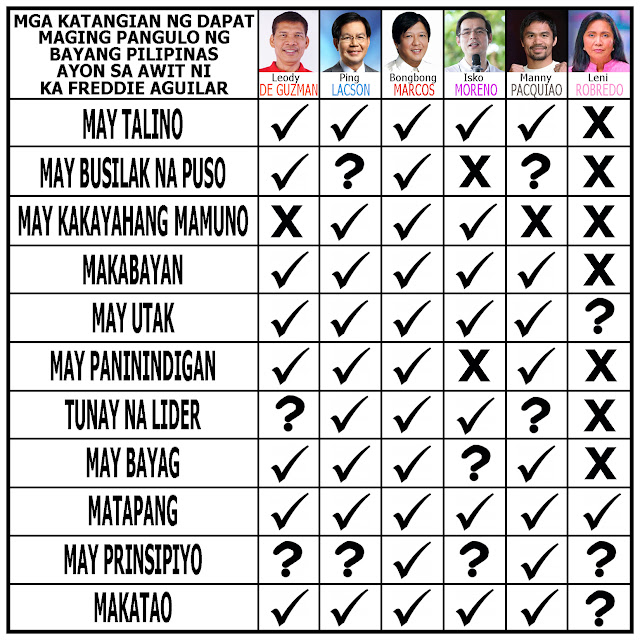
Mga katangian ng dapat maging Pangulo ng Bayang Pilipinas ayon sa awit ni Ka Freddie Aguilar. Kung susuriin si BBM lang ang meron ng lahat ng katangian. Si Ferdinand “Bongbong” Marcos din lang at si Panfilo “Ping” Lacson ang merong “F” at “A” sa kanilang pangalan, na initials ni Ka Freddie.

GETS NIYO NA KUNG PARA KANINO YUNG SONG!


02-27-2022

BIBLE TIME

“Blessed are those who rejects the counsel of the purveyors of evil, who refuse to follow the path of sinners, and who do not sit with scornful idolaters. Instead, they are joyous in obeying the Law of the LORD, and take it to heart night and day... For the LORD will guide the path of the righteous, but the deeds of the evil ones shall be damned.” – Psalms 1:1-2 & 6. (“Pagpalain ang mga tumatanggi sa payo ng mga nagpapalaganap ng kasamaan, ang mga umiiwas sa daan ng mga makasalanan, at ang mga hindi nauupong kasama ng mga manglilibak na sumasamba sa rebulto. Sa halip, sila ay masayang sumusunod sa Kautusan ng PANGINOON, at taglay ito sa puso araw at gabi... Sapagkat ang PANGINOON ay pumapatnubay sa daan ng matuwid, subalit ang mga gawa ng masasama ay mawawasak.” – Mga Awit 1:1-2 & 6).